
Why Does My Car Make a Clunking Noise When I Hit a Bump?
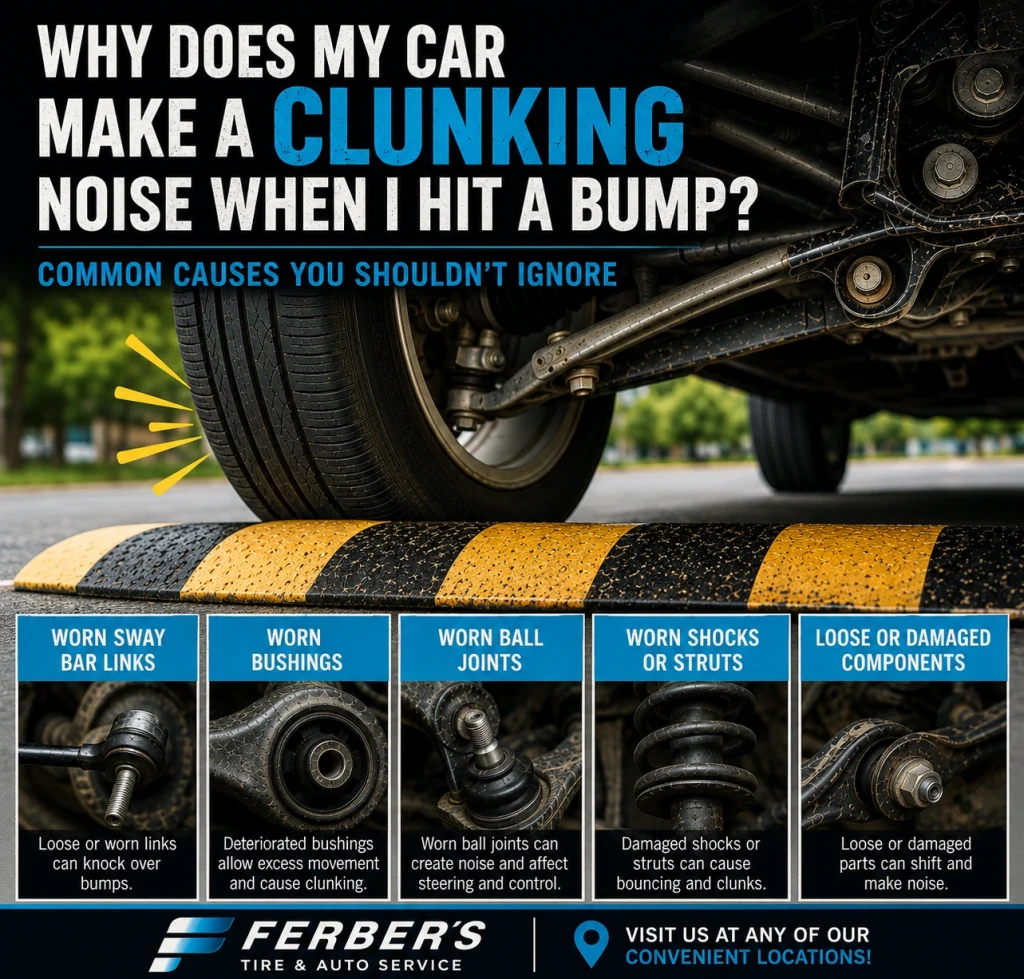
You drive over a pothole, speed bump, or rough patch of pavement and suddenly hear a clunk, knock, or thump from underneath your vehicle. Maybe it happens occasionally, or perhaps you’re starting to hear it every time the road gets rough.
A car making a clunking noise when hitting bumps is often telling you that something in the suspension or steering system has become loose, worn, or damaged. Your suspension contains numerous components that move whenever your wheels travel up and down. When bushings deteriorate, joints develop excessive movement, or hardware becomes loose, those components can make contact and produce the clunking sound you hear inside the vehicle.
At Ferber’s Tire & Auto Service, our ASE-certified technicians diagnose and repair suspension problems for drivers throughout Central Virginia. If your vehicle has started making unusual noises over bumps, identifying the cause early can help protect your tires, steering, handling, and other suspension components.
What Causes a Car to Clunk When Going Over Bumps?
Several suspension and steering components can create similar noises. That’s why determining exactly where the sound originates is more useful than simply replacing the component that seems most likely.
Worn Sway Bar Links or Suspension Bushings
Sway bar links are one of the common causes of clunking noises over bumps. Your vehicle’s sway bar helps control body roll when cornering, while the links connect the sway bar to other suspension components.
As the joints or bushings in these links wear, additional movement can develop. Going over a bump causes the suspension to move quickly, allowing the worn link to shift and create a knocking or clunking sound.
Suspension bushings can cause similar symptoms. Bushings are rubber or synthetic components that cushion connections between metal suspension parts. They reduce vibration while allowing controlled movement. Over time, heat, age, road debris, and normal wear can cause them to crack, deteriorate, or separate.
Once a bushing can no longer properly cushion a joint, you may hear metal components moving or contacting each other.
Ball joints and control arms are another possibility. Ball joints allow the suspension to move while the wheels turn, and control arms help maintain the proper position of the wheels relative to the vehicle.
A worn ball joint can develop excessive play, resulting in clunking or knocking noises as the suspension moves. You may also notice loose steering, uneven tire wear, wandering, or changes in handling.
Because ball joints and control arms play an important role in vehicle control, suspected problems should be inspected rather than ignored.
Worn Shocks, Struts, or Strut Mounts
Your shocks and struts help control the movement of the vehicle’s springs. Without them, your car would continue bouncing after every bump in the road.
As shocks or struts wear, you might notice excessive bouncing, a rough ride, increased body movement during turns, or nose-diving during braking. A damaged shock or strut can also create knocking or clunking noises.
However, sometimes the noise isn’t coming from the strut itself. A worn upper strut mount can create a noticeable clunk when the suspension compresses or rebounds. Because several components work together in the same area, a professional inspection can determine whether the problem is the strut, mount, spring, or another suspension component.
Ferber’s suspension repair services include inspection and repair of shocks, struts, ball joints, control arms, sway bar links, bushings, coil springs, wheel bearings, and related steering components.
Loose or Damaged Steering and Suspension Components
Not every clunk comes from a worn shock or bushing. Loose hardware, damaged springs, tie rods, wheel bearings, and other steering or suspension components can also produce unusual noises.
A broken or damaged coil spring, for example, may shift as the suspension moves. A worn tie rod may create looseness in the steering system, while wheel-bearing problems can sometimes produce noise that changes with vehicle speed or cornering.
Clunking may become especially noticeable after hitting a large pothole or curb. A hard impact can damage suspension components or knock the vehicle’s alignment out of specification.
That’s one reason it’s important to pay attention to symptoms beyond the noise itself. If your steering wheel is suddenly off-center, your car pulls to one side, or your tires begin wearing unevenly, you may need a professional wheel alignment in addition to suspension repairs.
Is It Safe to Drive a Car That Clunks Over Bumps?
The answer depends on what’s causing the noise.
A minor worn bushing may not create an immediate emergency, but a failing ball joint, steering component, spring, or other critical suspension part can affect your ability to safely control the vehicle. Because you can’t reliably determine the severity of the problem from the sound alone, persistent clunking should be inspected.
Pay particular attention if the noise is accompanied by loose steering, excessive bouncing, pulling, uneven tire wear, poor handling, vibration, or a change in braking behavior.
Your suspension isn’t only responsible for making the ride comfortable. It helps keep your tires in contact with the pavement and contributes to steering stability and predictable braking. When suspension components become worn or damaged, vehicle control can suffer.
Suspension problems can also contribute to premature tire wear. If a worn ball joint, control arm, tie rod, or other component changes the position of a wheel, the tire may no longer contact the pavement correctly. Simply replacing the tire won’t correct the underlying problem.
Similarly, a wheel alignment isn’t always enough. An alignment adjusts the angles of the wheels to manufacturer specifications, while suspension repair addresses damaged or worn mechanical components. When suspension parts are worn, they may need to be replaced before the vehicle can hold a proper alignment.
Ferber’s recommends a wheel alignment following many suspension repairs because replacing components such as struts, control arms, tie rods, or ball joints can alter suspension geometry.
If your vehicle has developed a clunk, knock, or thump when traveling over bumps, don’t wait for the sound to become louder. A professional inspection can pinpoint the source and help prevent unnecessary wear on surrounding components.
Ferber’s Tire & Auto Service provides suspension repair throughout Central Virginia, with convenient locations in Ashland, Fredericksburg, Richmond, and Midlothian.
Schedule an inspection at any of our five (5) central Virginia shop locations. We have shops in Ashland at 106 Junction Drive Ashland, VA 23005 and 10383 Leadbetter Road Ashland, VA 23005. If you’re in Fredericksburg, visit us at 9407 Onyx Court Fredericksburg, VA 22407, and if you’re in the Midlothian area, we have two shops there at 11201 Midlothian Turnpike, Richmond, VA 23235, and at 13937 Hull Street Rd N, Midlothian, VA 23112. Let our technicians determine what’s causing that clunking noise. Stop by or call us at 804-550-2886, or (804) 550-3535 in Ashland, (540) 898-8324 in Fredericksburg, and (804) 665-9500, or (804) 601-1110 in Midlothian.
Catching a worn suspension component early can help restore a quieter ride, improve handling, protect your tires, and keep your vehicle responding the way it should when the road gets rough.