
7 Signs Your Power Stroke, Cummins, or Duramax Diesel Needs Repair
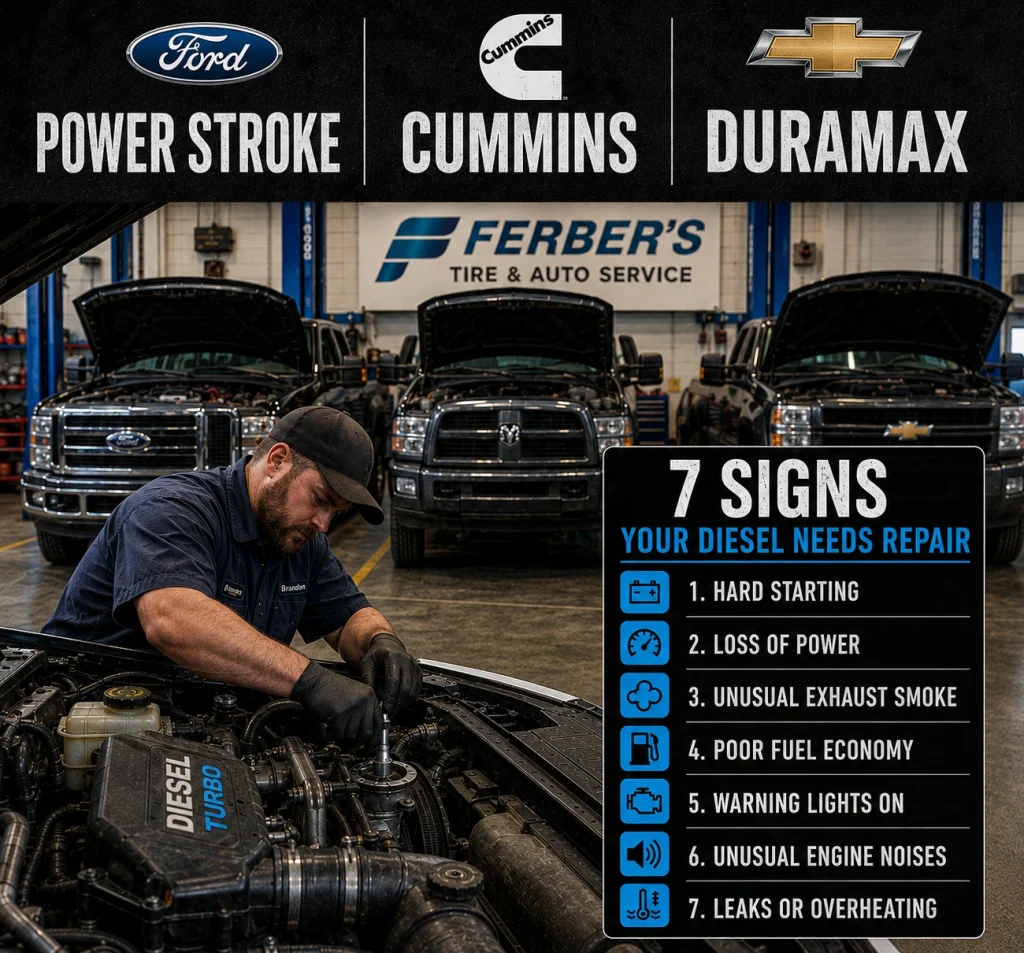
Diesel-powered trucks are built to work hard. Whether you drive a Ford with a Power Stroke, a Ram equipped with a Cummins, or a Chevrolet or GMC powered by a Duramax, your diesel engine is designed to deliver the torque, durability, and performance you depend on.
But even a well-maintained diesel can develop problems.
Hard starting, loss of power, unusual exhaust smoke, declining fuel economy, and warning lights can all indicate that something needs attention. The exact cause can vary significantly depending on the engine, model year, mileage, and symptoms, which is why proper diagnosis matters.
At Ferber’s Tire & Auto Service in Ashland, VA, we provide diesel maintenance, diagnostics, and repair. If your Power Stroke, Cummins, Duramax, or other diesel isn’t running like it should, watch for these seven warning signs.
What Are Common Signs Your Diesel Engine Needs Repair?
1. Your Diesel Is Getting Harder to Start
If your diesel suddenly cranks longer than usual or struggles to start—particularly when the engine is cold—don’t automatically blame the battery.
Depending on your diesel engine, starting problems can be associated with glow plugs or intake-heating systems, fuel pressure, injectors, electrical components, or other engine problems.
Power Stroke, Cummins, and Duramax engines don’t all use identical starting and fuel systems, so diagnosing the vehicle based on its specific engine is important.
2. You’ve Lost Power or Acceleration
One of the reasons drivers choose diesel trucks is torque. If your truck suddenly feels sluggish, struggles under load, or doesn’t accelerate as strongly as it used to, something may be interfering with engine performance.
Possible causes can involve fuel delivery, injectors, turbocharger operation, airflow, sensors, filters, emissions equipment, or other engine-management systems.
Rather than replacing parts based on symptoms alone, professional diagnostics can help isolate the problem. Ferber’s offers computer diagnostics when warning lights, trouble codes, or electronic engine-management issues are involved.
3. Your Diesel Is Producing Unusual Exhaust Smoke
A noticeable change in exhaust smoke can provide another clue.
Persistent black smoke may indicate that the engine isn’t burning fuel properly. Blue or blue-gray smoke can sometimes accompany oil consumption, while persistent white smoke may point toward incomplete combustion or other problems.
However, exhaust color alone isn’t enough to diagnose a Power Stroke, Cummins, or Duramax. Smoke should be evaluated alongside other symptoms such as rough running, coolant loss, oil consumption, difficult starting, or loss of power.
4. Your Fuel Economy Has Dropped
Diesel fuel economy varies with towing, payload, driving conditions, temperature, and driving habits. But if your normal MPG drops significantly without an obvious explanation, your truck may need attention.
Fuel-system problems, injectors, restricted filters, emissions-system issues, tire pressure, and other mechanical conditions can all affect efficiency.
If you’re visiting the fuel pump noticeably more often, don’t assume it’s simply part of owning an older diesel.
When Should You Schedule Diesel Repair?
5. Your Check Engine or Diesel Warning Light Is On
Modern Power Stroke, Cummins, and Duramax engines use sophisticated electronic controls to manage fuel delivery, turbocharger operation, emissions, and engine performance.
Depending on the truck, you may encounter a check engine light or a diesel-specific warning related to systems such as the diesel particulate filter (DPF), diesel exhaust fluid (DEF), or other emissions equipment.
A trouble code is valuable diagnostic information, but a code doesn’t necessarily mean the component named in the code is the part that failed. Testing is still needed to determine the root cause.
6. You’re Hearing a New Knock, Rattle, Whistle, or Other Noise
Diesel engines naturally make more mechanical noise than many gasoline engines, but owners tend to become familiar with how their trucks normally sound.
A new knocking, rattling, ticking, grinding, or whistling sound deserves attention. The timing of the noise can also be helpful. Does it occur during a cold start? At idle? During acceleration? When the turbocharger builds boost? Under a heavy load?
Changes in engine sound can originate from numerous components, so early diagnosis can help prevent a developing problem from becoming more extensive.
7. Your Diesel Is Leaking Fluid or Running Hot
Oil and coolant are critical to protecting any diesel engine, including Power Stroke, Cummins, and Duramax applications.
Watch for puddles underneath your truck, unexplained drops in oil or coolant level, unusual odors, or an engine temperature that’s climbing higher than normal.
Cooling-system problems are especially important to address quickly. A leaking hose, radiator, water pump, thermostat-related issue, or another cooling-system problem can eventually cause overheating and potentially serious engine damage.
Regular maintenance remains one of the best ways to protect your diesel. Oil and filter changes, fuel-filter service, cooling-system maintenance, transmission service, and other requirements should follow the recommendations for your particular truck and engine. Ferber’s provides factory-scheduled maintenance to help drivers stay current with manufacturer-recommended services.
If your Ford Power Stroke, Ram/Cummins, Chevrolet/GMC Duramax, or other diesel vehicle is hard to start, losing power, producing unusual smoke, using more fuel, or displaying a warning light, have the problem diagnosed before it gets worse.
Contact Ferber’s Tire & Auto Service at 804-550-2886, or visit us at 106 Junction Drive Ashland, VA 23005, for professional diesel repair in Ashland, VA. Our technicians can determine what’s causing the symptoms and recommend the appropriate maintenance or repair to keep your diesel performing reliably.