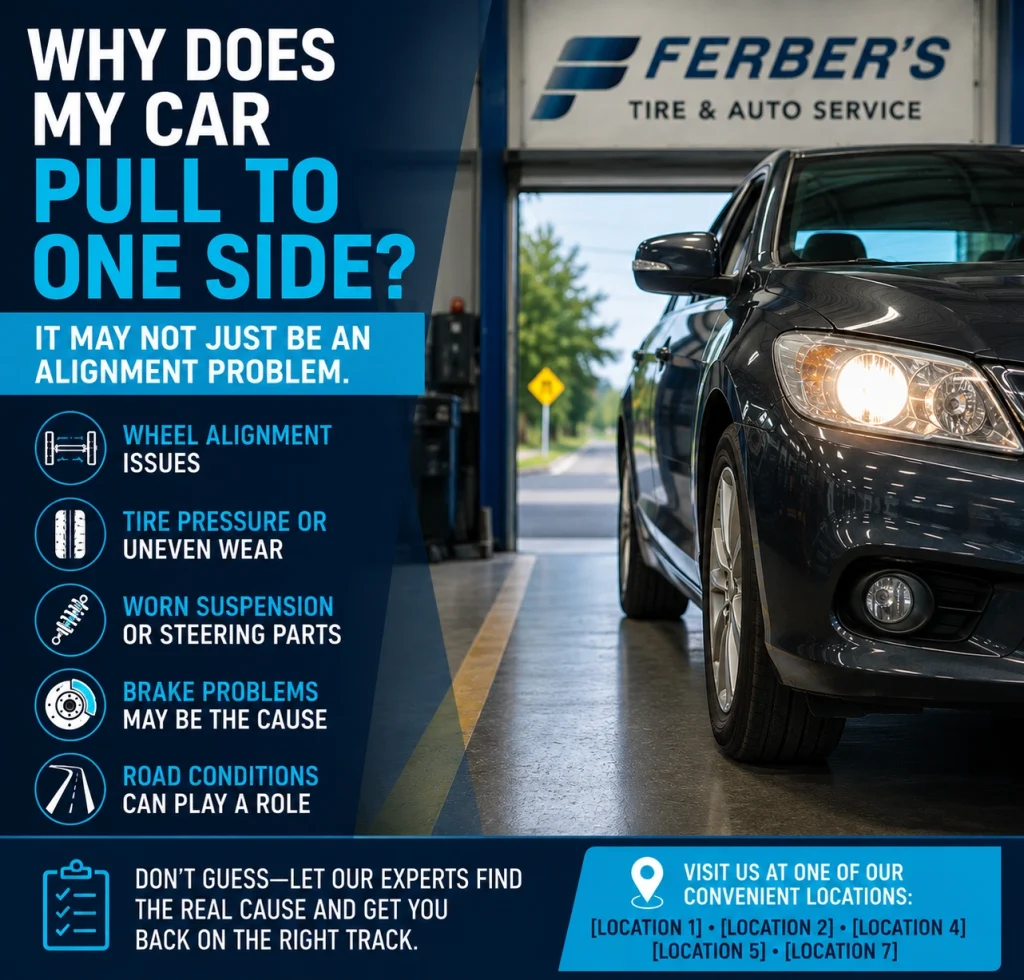
You’re driving down a relatively straight road, but your vehicle keeps drifting left or right. You find yourself making constant steering corrections just to stay centered in your lane. A wheel alignment may be the first thing that comes to mind, but a car pulling to one side isn’t always caused by poor alignment.
Tire problems, worn suspension components, and even brake issues can make a vehicle pull. Identifying when the pulling occurs and how the vehicle behaves can provide important clues.
At Ferber’s Tire & Auto Service, our technicians can inspect your tires, alignment, steering, suspension, and brakes to determine why your vehicle isn’t tracking straight.
Why Does My Car Pull Left or Right While Driving?
A slight drift can sometimes be caused by the crown of the road, which is designed to help water drain from the pavement. Consistent or significant pulling, however, deserves attention.
1. Your Wheel Alignment May Be Off
Improper wheel alignment is one of the most common reasons a vehicle pulls to one side. Your wheels are designed to sit at specific angles relative to the road and each other. Potholes, curb impacts, rough roads, worn suspension parts, and everyday driving can gradually change those angles.
Other alignment symptoms can include an off-center steering wheel, uneven tire wear, or a vehicle that wanders at highway speeds.
A professional wheel alignment measures camber, caster, and toe and determines whether adjustments are needed to return the vehicle to manufacturer specifications.
2. Tire Pressure or Tire Wear Could Be the Problem
Before assuming your vehicle needs an alignment, check the tires.
A significant difference in tire pressure from one side of the vehicle to the other can affect handling. Tire damage, mismatched tires, uneven tread wear, or certain tire-related conditions can also cause a vehicle to pull.
Inspect all four tires and check inflation when they’re cold using the pressure listed by your vehicle manufacturer. If one tire repeatedly loses pressure, have it inspected for a leak rather than continually adding air.
Ferber’s provides tire services including tire inspections, rotations, balancing, repair, replacement, and TPMS service.
3. Worn Suspension or Steering Components Can Cause Pulling
Your alignment depends on suspension and steering components holding the wheels in the correct position.
Worn ball joints, tie rods, control arms, bushings, struts, or other components can affect steering stability and wheel position. You might notice pulling along with clunking over bumps, loose steering, excessive bouncing, or unusual tire wear.
In these situations, performing an alignment without addressing the worn component may not solve the problem. The vehicle may not be able to maintain proper alignment until the underlying issue is repaired.
Ferber’s provides suspension repair to diagnose and repair these steering and suspension concerns.
What If My Car Only Pulls When I Brake or Accelerate?
When the pulling occurs matters. A vehicle that constantly pulls while cruising may have a different problem from one that suddenly pulls when you press the brake pedal.
If your car pulls to one side while braking, a brake problem may be responsible. A sticking caliper, uneven brake operation, or another braking-system issue can cause one side of the vehicle to slow differently than the other.
Pulling while braking may also be accompanied by unusual noises, vibration, excessive heat near a wheel, or changes in braking performance. Because the braking system is critical to vehicle safety, schedule a brake inspection if these symptoms occur.
Pulling or steering changes during acceleration can have other causes depending on the vehicle. That’s another reason a professional inspection is more useful than assuming every pulling problem requires an alignment.
If your vehicle has started pulling left or right, don’t simply compensate by holding the steering wheel at an angle. Continuing to drive with an unresolved problem could contribute to premature tire wear or allow a steering, suspension, or brake issue to worsen.
Visit Ferber’s Tire & Auto Service in Ashland at 106 Junction Drive Ashland, VA 23005, or call 804-550-2886. We have a second location in Ashland at 10383 Leadbetter Road Ashland, VA 23005, or call (804) 550-3535. In Fredericksburg, visit us at 9407 Onyx Court Fredericksburg, VA 22407, or call the shop at (540) 898-8324. We also have two locations in Midlothian, at [location-link location=5], or call (804) 665-9500. Our newest shop is located at 13937 Hull Street Rd N, Midlothian, VA 23112, or call us at (804) 601-1110.
Our technicians can determine whether your vehicle needs an alignment, tire service, suspension repair, brake repair, or another solution so you can get back to driving straight with confidence.