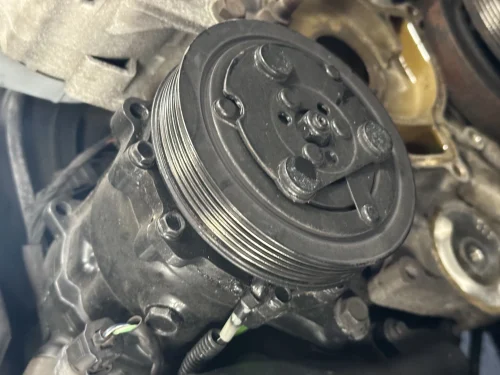
How does an AC Compressor work?
The AC compressor is akin to the beating heart of your car’s cooling system. Its primary function is to circulate refrigerant, a special fluid that absorbs and releases heat, transforming the air inside your vehicle from sweltering to comfortable.
Let’s break down the process:
First, the journey begins with the compressor’s intake of low-pressure, gaseous refrigerant from the evaporator coil. This refrigerant has just absorbed heat from your car’s interior, turning into gas. Once inside the AC compressor, the refrigerant faces a transformative squeeze. The compressor’s piston compresses the gas, significantly increasing its pressure and temperature. This is where the magic happens – the refrigerant transforms into a high-pressure, high-temperature gas.
Next, the now-hot, pressurized gas flows to the condenser, a heat exchanger located at the front of your car. The condenser’s primary job is dissipating the heat the refrigerant absorbs, allowing it to cool down. As the refrigerant sheds its heat, it transforms into a liquid state. This liquid gold then travels to the expansion valve, undergoing a rapid pressure drop. The sudden drop in pressure causes the refrigerant to evaporate, absorbing heat from the surrounding air in the process. This cold, low-pressure gas is then directed back into the evaporator coil inside your car, ready to start the cycle anew.
With its intricate dance of compression and expansion, the AC compressor plays a pivotal role in keeping you cool during the hottest days. Understanding its inner workings enhances your appreciation for the engineering marvel under your car’s hood and empowers you to keep it running smoothly. So, the next time you enjoy a refreshing blast of cool air, thank the unsung hero – your car’s AC compressor. For diagnostic and other AC services, call a shop you can trust, like Ferber’s Automotive and Body!